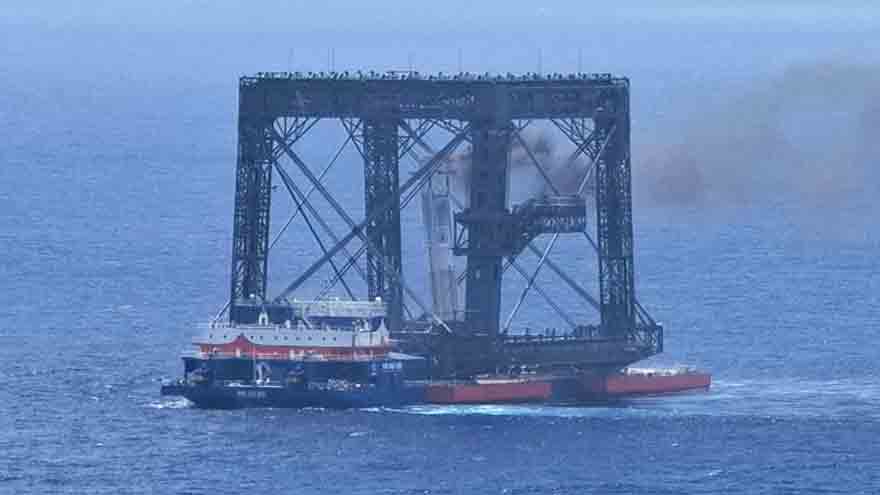
(Web Desk) – China has successfully landed a reusable rocket for the first time, marking a “historic breakthrough†for the country’s space technology._x000D_
_x000D_
The Long March 10B rocket was launched from the Hainan commercial spacecraft launch site in south China’s Hainan Province._x000D_
_x000D_
After separation of its two stages, the first stage returned and was successfully caught upright on sea-borne net-capture platform._x000D_
_x000D_
The rocket also flew a satellite into “its predetermined orbit†on Friday, state news agency Xinhua reported._x000D_
_x000D_
“Approximately six minutes after the first and second stages separated, the first stage returned vertically and was successfully recovered at a sea-based recovery platform using a net system,” China Aerospace Science and Technology Corporation (CASC) said in a statement._x000D_
_x000D_
“It signifies a historic breakthrough for my country in the field of reusable rocket technology and will lay a solid foundation for accelerating the improvement of my country’s space access capabilities,†CASC said._x000D_
_x000D_
China’s Long March 10B rocket has been compared to the SpaceX Falcon 9._x000D_
_x000D_
Developed by the country’s main state rocket developer, the China Academy of Launch Vehicle Technology (CALT), it is capable of carrying a payload of at least 16 metric tons to low-Earth orbit._x000D_
_x000D_
But unlike the Elon Musk-owned company’s pioneering rocket, the Long March 10B does not autonomously use deployable legs to land on a ship or a ground-based pad._x000D_
_x000D_
Instead, it uses “landing hooks” to latch onto the net attached to a sea-borne platform, Xinhua reported._x000D_
_x000D_
“Net-based recovery helps simplify the rocket’s onboard structure, reduces vehicle mass and increases payload capacity. It is also highly adaptable to landing-point deviations, as coordinated net â systems can effectively expand the capture window,” CALT expert Chen Muye told Chinese state media._x000D_
_x000D_
So far, SpaceX has demonstrated rocket recovery in 2015, followed by the Jeff Bezos-owned Blue Origin in November last year._x000D_
_x000D_
SpaceX has launched its Falcon 9 nearly 150 times a year, and even reused its recovered rocket dozens of times._x000D_
_x000D_
Meanwhile, China has spent nearly a decade developing reusable rockets, first testing low-altitude space vehicles and later experimenting with long-range orbital-class booster recovery._x000D_
_x000D_
The Long March-10B rocket is a reusable liquid-fueled vehicle built for commercial launches and stands approximately 63m (206ft) tall with a diameter of 5m (16ft)._x000D_
_x000D_
Its first stage burns kerosene and liquid oxygen (LOX), while the second stage uses LOX and liquid methane, according to CALT.
