
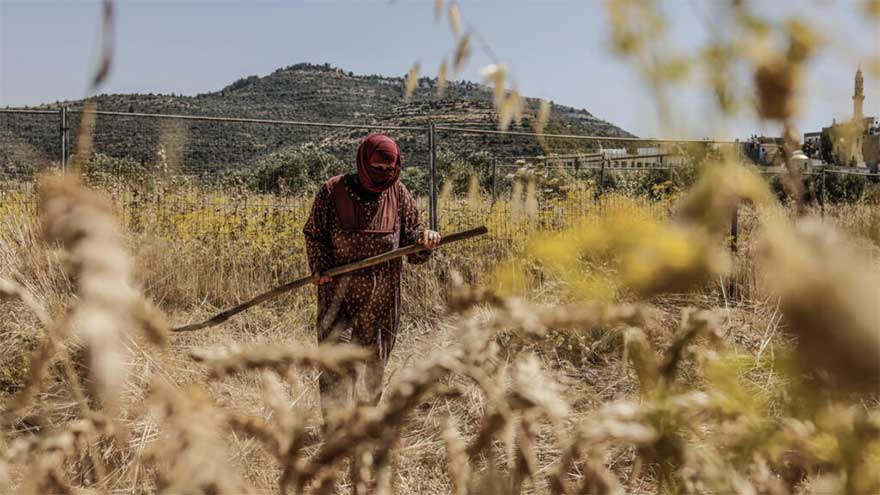
AS SAWIYAH (Palestinian Territories) (AFP) – With pitchforks and a makeshift combine the size of a golf cart, Hamad Jazi and his nephews race under the blazing sun to collect wheat from their West Bank field.
_x000D_
Israeli settlers have recently set fire to crops in the area, and Jazi fears his wheat could suffer a similar fate.
_x000D_
Their village of As-Sawiyah, in the centre of the occupied West Bank, sits in a valley dominated by hills on top of which three settlements stand.
_x000D_
“The settlers have set fires twice already – yesterday and the day before,” Jazi told AFP.
_x000D_
“If you think back 10, 15 or 20 years ago, this season used to be a season of abundance. Today, you are racing against time just to harvest quickly and leave,” he added.
_x000D_
Excluding east Jerusalem, more than 500,000 Israelis live in the occupied West Bank in settlements that are illegal under international law, among some three million Palestinians.
_x000D_
Israel has occupied the West Bank since 1967.
_x000D_
Shielded by what rights groups describe as impunity from the law, some settlers have harassed rural Palestinian communities, vandalising property and crops, committing arson and sometimes killing.
_x000D_
By all metrics, 2026 has been one of the most violent years to date, with an average of six attacks per day, according to data from UN humanitarian agency OCHA.
_x000D_
The surge in violence goes hand in hand with the proliferation of settlements in the West Bank, which part of the Israeli political class is threatening to annex.
_x000D_
Settlers in rural areas vandalise property and start fires, at times sowing terror in villages, as shown in videos posted on social media, sometimes by the perpetrators themselves.
_x000D_
Settlers in rural areas vandalise property and start fires, at times sowing terror in villages._x000D_
_x000D_
The attacks have sparked criticism inside Israel, where the opposition accuses Prime Minister Benjamin Netanyahu’s government and his far-right allies of turning a blind eye to acts of settler violence.
_x000D_
According to Mahmud Fatafta of the Palestinian Authority’s agriculture ministry, settlers killed or stole 8,000 goats or sheep in the West Bank in 2026.
_x000D_
According to his ministry’s data, 41,000 olive trees, a crop as emblematic to Palestinians as it is ubiquitous in the West Bank’s rocky hills, were damaged by settlers or Israel’s military in 2026.
_x000D_
‘Steal our own crops’
_x000D_
“In the past, when we went out into the fields, the olive harvest was a celebration, the grain harvest was a celebration,” Jazi, his face worn by the sun, told AFP.
_x000D_
Now, “we live those moments like thieves. We go and ‘steal’ our own olives or our own crops”, he said, complaining that the Israeli military requires him to coordinate with it before entering his fields.
_x000D_
Hikmat Abu Ras, head of As-Sawiya’s village council, told AFP that his and neighbouring communities have faced near daily attacks from settlers since the start of the war in Gaza in October 2023.
_x000D_
“They constantly carry out these practices in order to drive us off our land and prevent us from entering it,” he said.
_x000D_
Abu Ras lamented increasing movement restrictions that further isolate communities like his.
_x000D_
“Gates block the entrances to villages, camps, and cities. Movement is restricted. You race against time just to make sure the settler does not come and seize what is on your land.”