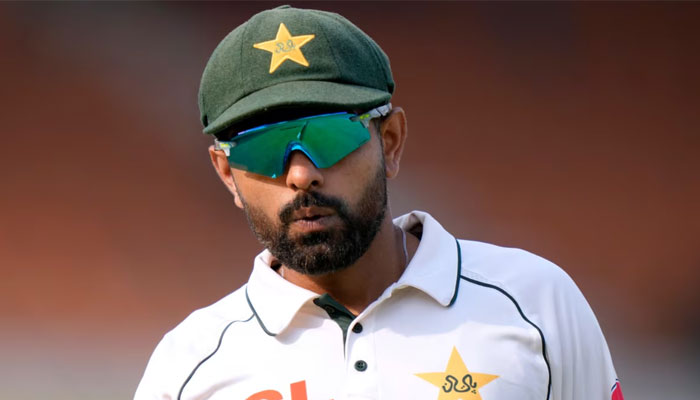
Pakistan cricket has seen days when global victories were our destiny and there was also a period when successful captains were stripped of power immediately after their success._x000D_
_x000D_
Even after the historic victory in the 1992 World Cup, news of differences and rebellion against former captain Imran Khan came to light. Younis Khan, who led the team to victory in the 2009 T20 World Cup, faced a rebellion from his teammates shortly after. Sarfaraz Ahmed, who won the 2017 Champions Trophy, was also eventually stripped of the captaincy. One thing remained common in all these examples: this successful captain who brought Pakistan world honors did not appear in this position again._x000D_
_x000D_
But Babar Azam proved to be different from this tradition. He turned out to be so lucky that as a captain he could not bring Pakistan the international honor that his predecessors had brought, despite this, he succeeded in crowning the national team leadership for the third time. This fact raises many questions about the Pakistan cricket system today._x000D_
_x000D_
If new leaders have not been developed in the last few years, then who is responsible for this?_x000D_
_x000D_
When the Pakistan Cricket Board’s selection committee announced the Test squad for the tour of West Indies and England, all the explanations of selection committee member and director of the High Performance Center Aqib Javed revolved around the 12 Test defeats under the leadership of Shan Masood. According to him, the responsibility of the captain is not only to stand on the field, but also to lead the team to success, maintain the over-rate, make the right DRS decisions and adopt the appropriate strategy at the time of the toss._x000D_
This same Aqib Javed was prominent among the critics of Babar Azam’s leadership in the past, but time has taken such a turn that now he does not see any other suitable candidate other than Babar Azam. The question is, if new leaders have not been developed in the last few years, then who is responsible for this?_x000D_
Is it fair to put the burden of every failure of the team on the shoulders of the captain alone?_x000D_
Babar Azam led Pakistan in 20 Test matches, out of which 10 were won, meaning his success rate was 50 percent. On the other hand, in the 2023 World Cup, the national team was eliminated from the event in the first phase. After that, the then chairman Zaka Ashraf suggested removing Babar Azam from the captaincy of the white-ball team only and retaining the Test leadership, but Babar Azam did not accept it._x000D_
_x000D_
Later, as soon as the chairman changed, Babar Azam was once again appointed as the captain of the T20 team, however, the defeat at the hands of a novice team like America in the T20 World Cup also raised serious questions about his leadership skills. Undoubtedly, Shan Masood was removed on the basis of poor results, but is it fair to put the burden of every failure of the team solely on the shoulders of the captain? Babar Azam himself had faced difficulties in the past due to the pressure of captaincy, and his batting form was also affected. If only the captain is changed after every failure and the system, selection, coaching and planning are kept above accountability, then how can we hope to change the results? Successful teams in the world have different ideas regarding leadership. The real question is that if new leaders are not given confidence and time, where will Pakistan’s next successful captain come from?_x000D_
_x000D_
The world’s successful cricket teams have different views on this matter. South Africa handed over the Test team leadership to Graeme Smith, who was only 22 years old, in 2003, even though he had only played nine Test matches at that time. At that time, the team had world-class senior players like Herschelle Gibbs, Gary Kirsten, Jacques Kallis and Shaun Pollock. But Cricket South Africa invested in the future. The result was that the senior players supported the young captain, created a conducive environment and Graeme Smith became the most successful captain in South Africa’s history with 54 Test victories._x000D_
_x000D_
On the contrary, in Pakistan, Shan Masood was handed the captaincy, but he could not be provided with the confidence, stability and environment that are indispensable for the success of any new leader. The result was that the leadership appeared lonely on the field and this was reflected in the form of continuous poor results._x000D_
_x000D_
Successful cricket is born not only from good players but also from clear policies and consistent leadership_x000D_
The Pakistan Cricket Board’s appointment of Babar Azam as captain once again is in fact an admission that Pakistan is not just suffering from a batting or bowling crisis, but also from a leadership crisis. When the same face repeatedly becomes the only alternative, it is not the failure of an individual but of the entire system._x000D_
_x000D_
Successful cricket is born not only from good players but from a strong system, clear policies and consistent leadership. If only the captain is made the scapegoat after every defeat and the system does not hold itself accountable for its mistakes, then changing faces will not change the results. More than a new captain, Pakistan cricket today needs a new vision, consistency and an administrative structure that creates leadership and also trusts it, otherwise the captains will keep changing, but the crisis in Pakistan cricket will remain in place. ( courtesy Geo NEWS)
