
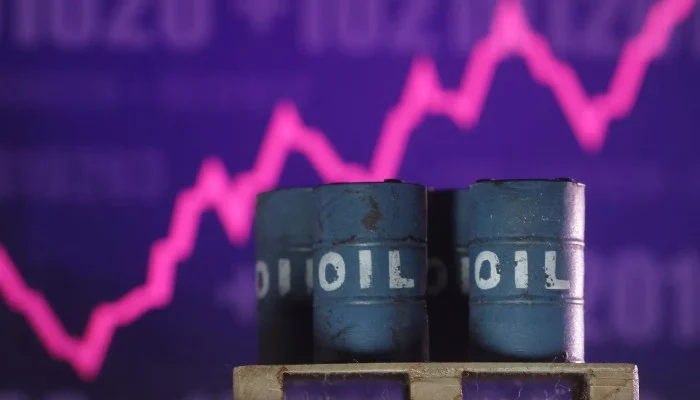
Brent oil prices jumped more than $3 a barrel on Monday, initially spooked by Israel’s launch of renewed strikes on Lebanon a day earlier, but also gaining further steam after sounds of explosions were heard in Iran._x000D_
_x000D_
_x000D_
Sounds of blasts were heard – in Tehran, Tabriz and Isfahan, local media reported early on Monday, eroding hopes for an imminent end to the wider war and a restart to crude flows through the Strait of Hormuz._x000D_
_x000D_
Brent crude futures rose $3.20 or 3.39% to $96.24 a barrel â while US crude futures were up $2.87 or 3.17% at $93.41 per barrel as of 0333 GMT._x000D_
_x000D_
Those gains erased Friday’s losses, when prices fell on hopes of a de-escalation in the US-Iran conflict, which has seen oil prices rise over 50% since March._x000D_
_x000D_
Though Iran on Sunday fired a salvo of missiles at Israeli targets in retaliation, US President Donald Trump insisted that an agreement to end the wider war remains well within reach._x000D_
_x000D_
Trump also reportedly told Israeli Prime Minister Benjamin Netanyahu to refrain from further attacks._x000D_
_x000D_
“It’s not going to have any impact on the deal,” Trump told the Financial Times. “I call the shots. I call all the shots. He doesn’t call the shots.”_x000D_
_x000D_
Iran has made a ceasefire with Lebanon a â condition for a peace deal with Washington._x000D_
_x000D_
Israel invaded Lebanon in March after Iran-backed Hezbollah fired rockets and drones across the border. Lebanon and Israel said on June 3 that they had agreed to a ceasefire following negotiations in Washington._x000D_
_x000D_
The two countries had previously agreed to a cessation of hostilities in April but violence continued._x000D_
_x000D_
The wider war has been stalemated since the US and â Israel paused their attacks on Iran in early April, with Tehran blocking most shipping through the Strait of Hormuz, the main transit route for one-fifth of the world’s oil. Washington has imposed its own blockade of Iranian ports._x000D_
_x000D_
Amid the resulting supply crisis, OPEC+ on â Sunday agreed its fourth increase in oil output in four months. But analysts said the decision would have little impact since most OPEC+ members could not meet their output targets because of the Hormuz closure or, in â the case of Russia, infrastructure attacks that have eroded its production capacity._x000D_
_x000D_
“In the current market, the physical impact of such a decision would be close to zero,” Rystad Energy’s head of geopolitical analysis, Jorge Leon, said in a note to clients._x000D_
_x000D_
_x000D_
Sounds of blasts were heard – in Tehran, Tabriz and Isfahan, local media reported early on Monday, eroding hopes for an imminent end to the wider war and a restart to crude flows through the Strait of Hormuz._x000D_
_x000D_
Brent crude futures rose $3.20 or 3.39% to $96.24 a barrel â while US crude futures were up $2.87 or 3.17% at $93.41 per barrel as of 0333 GMT._x000D_
_x000D_
Those gains erased Friday’s losses, when prices fell on hopes of a de-escalation in the US-Iran conflict, which has seen oil prices rise over 50% since March._x000D_
_x000D_
Though Iran on Sunday fired a salvo of missiles at Israeli targets in retaliation, US President Donald Trump insisted that an agreement to end the wider war remains well within reach._x000D_
_x000D_
Trump also reportedly told Israeli Prime Minister Benjamin Netanyahu to refrain from further attacks._x000D_
_x000D_
“It’s not going to have any impact on the deal,” Trump told the Financial Times. “I call the shots. I call all the shots. He doesn’t call the shots.”_x000D_
_x000D_
Iran has made a ceasefire with Lebanon a â condition for a peace deal with Washington._x000D_
_x000D_
Israel invaded Lebanon in March after Iran-backed Hezbollah fired rockets and drones across the border. Lebanon and Israel said on June 3 that they had agreed to a ceasefire following negotiations in Washington._x000D_
_x000D_
The two countries had previously agreed to a cessation of hostilities in April but violence continued._x000D_
_x000D_
The wider war has been stalemated since the US and â Israel paused their attacks on Iran in early April, with Tehran blocking most shipping through the Strait of Hormuz, the main transit route for one-fifth of the world’s oil. Washington has imposed its own blockade of Iranian ports._x000D_
_x000D_
Amid the resulting supply crisis, OPEC+ on â Sunday agreed its fourth increase in oil output in four months. But analysts said the decision would have little impact since most OPEC+ members could not meet their output targets because of the Hormuz closure or, in â the case of Russia, infrastructure attacks that have eroded its production capacity._x000D_
_x000D_
“In the current market, the physical impact of such a decision would be close to zero,” Rystad Energy’s head of geopolitical analysis, Jorge Leon, said in a note to clients._x000D_
_x000D_