
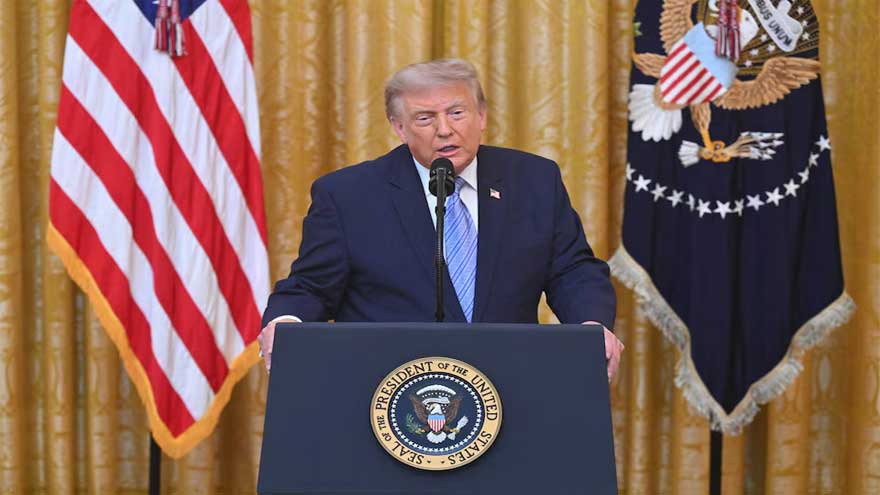
WASHINGTON (Reuters) – US President Donald Trump declassified documents on Thursday that he asserted showed Chinese interference in US elections, reviving his long-running attacks on election security despite a US intelligence assessment that found no evidence Beijing affected the 2020 vote that he lost.
_x000D_
The 25-minute prime-time address underscored Trump’s effort to make election security a central political issue ahead of November’s midterm elections, when his fellow Republicans will be defending their slender congressional majorities.
_x000D_
Trump ‌used his remarks to again press Republicans in Congress to pass legislation imposing new voter identification and citizenship requirements, despite longstanding findings that voter fraud in US elections is rare. The bill has stalled in the Senate amid fierce Democratic opposition.
_x000D_
TRUMP ASSERTS ‘SHOCKING VULNERABILITIES’
_x000D_
Trump said the declassified material would reveal “shocking vulnerabilities in our election infrastructure.” But many appeared to show the opposite, or were not related to US election infrastructure at all.
_x000D_
The speech came at a challenging political moment for Trump and Republicans, with his approval rating weighed down by the unpopular Iran war and high energy prices. Trump briefly mentioned the war at the outset, saying the US was “winning big,” while listing a series of domestic accomplishments, including tax cuts and his immigration crackdown, before turning to election security.
_x000D_
The president said he was declassifying sensitive information that showed China had illicitly acquired 220 million US voter files, including names, addresses and other data.
_x000D_
He asserted that members of the US intelligence community deliberately suppressed information about the extent of China’s activities.
_x000D_
An unclassified 2021 US â intelligence assessment found no indications any foreign actor attempted to or succeeded in altering “any technical aspect” of the 2020 presidential election vote, including voter registrations, ballots, tabulations or results.
_x000D_
That assessment was conducted under John Ratcliffe, then Trump’s director of national intelligence and now his CIA director.
_x000D_
The report also found China had pursued an effort dating to at least 2008 to collect information on US voters, public opinion, political parties, candidates and top government officials, likely aiming to use the material to predict election results.
_x000D_
Two people familiar with the matter said the US voter data obtained by China was not confidential – voter files are routinely purchased by political consultants – and could not be manipulated.
_x000D_
Ahead of Trump’s speech, some White House officials expressed concern that disclosing the China information could be misleading, sources told Reuters.
_x000D_
Trump’s harsh language about China risked rocking a relationship that has steadied following last year’s costly trade war. Trump hopes to meet with Chinese President Xi Jinping in September about improving trade relations.
_x000D_
China’s Foreign Ministry did not immediately respond to a request for comment on the speech. Before the address, Liu Chang, spokesperson for the Chinese embassy in Washington, said: “China has never and will never interfere in the presidential elections of the US.”
_x000D_
FAMILIAR CLAIMS GOING BACK YEARS
_x000D_
Trump has spent years raising doubts about electoral outcomes, falsely asserting that his 2020 loss to Democrat Joe Biden was rigged. He has also ​advanced other false claims, including that mail-in balloting is rife with fraud, voting machines are untrustworthy and non-citizen voting is widespread.
_x000D_
Numerous courts and vote recounts found no evidence of large-scale fraud in the 2020 election.
_x000D_
Nevertheless, Trump’s campaign has gained traction with his supporters. A Reuters/Ipsos poll in ‌April found 63% of Republicans â believe Trump’s claim that the 2020 election was stolen, a share that has remained largely unchanged in recent years despite the absence of evidence.
_x000D_
Trump said on Thursday that his administration had uncovered evidence of more than 275,000 non-citizens registered to vote in just four states, but it was not clear how many had actually voted.
_x000D_
In some previous cases, systems intended to verify citizenship status have mistakenly flagged some naturalized US citizens as non-citizens. Studies have found that non-citizens casting actual ballots is exceedingly uncommon.
_x000D_
Trump also said that the newly declassified documents would reveal serious weaknesses in election security. But many either appeared inconsistent with that assertion or were unrelated to US election infrastructure:
_x000D_
* One CIA document, prepared last month, concerned Venezuela’s election, not America’s.
_x000D_
* “We assess that vote tabulation systems would be difficult to ​manipulate on a wide enough scale to compromise election results,” another ​document said.
_x000D_
* A third document, produced by the CIA, â detailed efforts by Chinese spies to target Biden’s campaign and noted that Beijing “does not currently intend to covertly interfere to try to sway the outcome of the election,” although it said China might later decide to do so.
_x000D_
“Trump’s shocking ‘bombshells’ about China are totally bogus,” Democratic Senator Mark Warner, vice chair of the Senate Intelligence Committee, said in a statement during the speech. “The fact is our intelligence agencies unanimously agreed that China did not even try to change a single vote in the 2020 election.”
_x000D_
POLITICAL HEADWINDS
_x000D_
While Trump cast US elections as highly vulnerable, he did not provide evidence of any actual votes in 2020 â that were altered or manipulated.
_x000D_
Two of the three major US television networks and CNN decided not to broadcast the speech on their primary platforms, eschewing a practice typically reserved for major addresses on issues of national import.
_x000D_
Trump again urged Republican lawmakers to advance a bill, the SAVE America Act, that would require photo ID to vote and proof of US citizenship to register and would significantly curtail mail-in voting. Democrats and voting-rights advocates say the legislation is intended to suppress legitimate votes.
_x000D_
The bill has passed the Republican-controlled US House of Representatives several times with â a simple majority, but it does not have the 60 votes to overcome a Democratic filibuster in the Republican-controlled Senate.
_x000D_
Some Republican leaders have urged Trump to focus on issues that matter most to Americans, including high living costs, rather than focus on the 2020 vote.
_x000D_
Democrats need to flip only three Republican seats to take a majority in the 435-seat US House. They face an uphill battle to win control of the 100-seat Senate with critical races unfolding in Republican-leaning states.